The lyrics to Don’t Laugh at Me speak to anyone who has felt like an outsider. Whether or not you were bullied as a child, this song will likely resonate with you. Steve Seskin, the singer-songwriter, and his co-writer were first inspired by a young girl’s experience of teasing in grade school. But, the song encompasses inequities experienced by those living with physical and developmental disabilities as well as people experiencing hard times.
A few months ago I [Leslie] first heard the song in the online dance class, Rumba with Tina. Many of the other virtual dancers were familiar with it and sang along. I just cried. After the class I googled the song title and discovered I knew the songwriter. Steve’s wife, Ellen, has been a participant in the Northern California Myotonic Dystrophy Support Group I facilitated. What a small world!
Steve’s songs have been recorded by recording artists such as Garth Brooks, Reba McEntire, Waylon Jennings, Tim McGraw, Colin Raye, and Mark Wills. Visit Steve’s website to learn more about his music and check out the organization Steve is involved with: Operation Respect.
Do you see images of yourself reflected in popular media? As a person with a chronic health condition and/or disability, is your life reflected in movies, television, print, or social media?
In this themed podcast episode you’ll hear from Christophe Zajac-Denek — an actor, musician, surfer, skateboarder, and little person — whose podcast, I’m Kind of a Big Deal, explores the unique lives of people with dwarfism. Christophe has worked in Hollywood movies for 11 years but rarely do you see his face.
Lindsey Kizer, recently diagnosed with narcolepsy, appeared in an earlier podcast episode. Her experience of narcolepsy reflected in media has usually been a joke with the character falling asleep mid-sentence.
John Poehler is a published author and award-winning blogger in Colorado. Diagnosed with bipolar disorder in 1999, John’s memory of mainstream media’s representation of people with bipolar disorder was far from accurate.
Daniel G. Garza, an HIV/AIDS patient leader, advocate, and educator talks about the first movie where he saw characters portrayed with HIV/AIDS. Daniel has a blog/podcast and YouTube channel.
Ania Flatau, an avid dancer born with spina bifida, was featured in a previous podcast episode, Ania has never seen spina bifida represented in popular movies or television but she is quite proud of a certain wheelchair skater, Aaron Fotheringham.
For those with myotonic dystrophy, like myself, all we have is this documentary, Extremis.
Transcript
welcome to glass half full with leslie krongold she shares her stories experiences and knowledge of living and coping with a chronic health condition learn about tools and resources and hear inspirational interviews that help you to live a life filled with quality and dignity with two decades of support group leadership leslie’s ready to help you make lemonade out of life’s lemons are you ready are you ready welcome to the glass apple it’s our first episode for 2021 took a little break no vacation just working on social media the website search engine optimization oh so many things behind the scenes but we’re back this episode is all about how we’re represented in popular media on television in movies print and social media whether we have a chronic illness a disease and or disability are we seeing ourselves reflected in popular media i know i’m not i think i can safely say i’ve never seen a character with myotonic dystrophy on a tv show or in a movie well there is a documentary it’s called extremists extremists extremists and it’s about a palliative care doctor and one of her dying patients has myotonic dystrophy it was incredibly painful to watch and several years ago there was a tv medical drama called royal pains i didn’t watch this series but i saw facebook posts from people in my patient community that there was an episode that mentioned myotonic dystrophy so i mean sure i found that episode i uh i marched it only to be let down it mitotic dystrophy was mentioned as a possible diagnosis for a patient i don’t even think you saw the patient but it was quickly discounted so like you could sneeze and miss the whole thing so again to thinking about the power of medium representation over the last few months i’ve interviewed a few people people with different health conditions or disabilities to hear if they felt represented in popular media the first person you’ll hear from is Christophe Zajac-Denek that’s a hyphenated last name not just multi-syllabic i met kristoff at a virtual podcast conference he’s originally from detroit but because of his avid interest in surfing skateboarding and punk rock he made his way to southern california Christophe identifies as a little person and has a podcast called i’m really a big deal he shared with me that there are between 200 and 250 different types of dwarfism and people exhibit different symptoms depending on which type of dwarfism they have the condition that Christophe has is called cartilage hair hypoplasia in your lifetime how have you seen the media change in the representation of little people and when when did the term little people become i’m assuming it’s acceptable yeah like are people that you met in your community do any people resent that term or is it a term that came out of your community sure yeah those those are really important questions the tour i’ll start with the term little person the term little person is acceptable um you could also say dwarf however when i’ve posed this to guests on my show some of them have strong feelings
in us in a way that they don’t that doesn’t define them and so they don’t want to be called a little person or a dwarf they just want to be called by their name and just like we all do you know your condition does not define who you are so in that same breath that’s the same with us you know little person is it’s it’s fine it’s pc so is dwarf you know um [ _ ] or the m word as people refer to it as is not okay um you know but words are just words in a in a sense and if if somebody actually wants to come up and have a conversation with me and say you know if they were to call me a [ _ ] or something like that and i wanted to if i saw value in the in the conversation or you know where where this was somebody that was just maybe misdirected or something like that and even if they’re not you know it’s still okay to say hey that’s offensive and that’s not all right to call somebody out like that my name is Christophe in fact another guest on my show does that and he is incredibly brave um whether they call him out as an offensive term or not he will go up to people and say hey you know the proper terminology is this but also my name is joseph and it’s nice to meet you and i was born this way and he interacts with kids on this level and i i never would be i i’ve never been able to do that before you know maybe this past year or two because you know it’s still accepting yourself and all of my friends that i’ve shown that to as well they’re like that’s so cool i don’t know that i got the balls to do that just to you know go up to a mother and a child and to confront the situation and and because with each situation that passes if it’s not rectified or if there isn’t some sort of positive interaction or a teaching moment or something like that that’s a moment that’s lost and that’s another moment that goes by where it’s okay to maintain confusion about how to interact with us or other people with disability you know and to me the whole reason why we have that is because the media doesn’t include us you know i’ve worked a lot of show i’ve worked in hollywood for 11 years and you’ve seen my face once maybe twice you know and it’s not because i haven’t worked it’s because hollywood covers me up for everything you know my face is covered in prosthetics or makeup or just costumes and masks and crazy wardrobe and things like that and trust me i want to do that stuff because it’s fun and i can do that stuff and i need the work so please pay me but also you know you just complimented me on my face and i’m not searching for compliments but i’m not this disgustingly grotesque object that seen in a commercial or in and i’m not saying myself i’m saying all of us you know everyone everyone that meets my friends with dwarfism think that they’re incredible they’re like your friend is so cool how they’re so awesome i never you know knew another little person before them or you know before you or whatever and it’s the personality that shines through right and that becomes inaccessible when little people are hired as props or just warm bodies to move around a costume or some foam or something like that and so that’s how i see how society sees us you know and it’s taken me a long time to figure that out because remember how i said i would get paid you know 10 to 100 times as much you know in a costume as i would get playing music well there’s the there’s the hook right there right money but then once you start to think about it and you you’re thinking okay well i’m i’m not getting any equity on my face or my skill because i’m in a costume they could have hired anybody and there’s just a list and if whoever said the first yes is going to get the job so it doesn’t matter you know what i look like in that regard and i think that that’s sad and i i do think some stuff in hollywood is turning around for the better with that i mean peter dinklage is blazing a trail and he’s awesome and i’m i’m really proud of him and what he’s done and the station agent i love that you mentioned that film that film is is incredible that when i first saw that i was thinking who knew who knew about me this is crazy it’s actually i’ve identified with that so much and just more of that is what i think we need and you know even when there are certain things that in my eyes are exploitative i still see there’s a part of me that still sees value in you know like the little women of la and dallas in new york and stuff i mean it’s a reality show so there’s going to be ridiculous drama and things going on but still you get to see little people you know it’s it’s not i i don’t see that as steps backwards i see it as steps forward even though it’s it it’s this fantastic thing and it’s it’s reality tv and stuff like that i i respect that there’s a show that that shows us you know and and because you have to work on opening the door somehow and i think that you know what tara created is important and it’s good and it’s gotten attention of a lot of people the next person i spoke with is Lindsey Kizer in north carolina Lindsey appeared in an earlier podcast episode about coping with COVID she was diagnosed over a year ago with narcolepsy what do you think the biggest misconception people have about narcolepsy you know whether it’s friends or family members just in general i think you know most people think it is like what you see on tv you know where someone can be you know mid-sentence or you know doing whatever normal activities and they just in an instant fall asleep out of nowhere and that’s not how it happens at all you know i don’t really know where that has come from um because even that’s not even something recent as far as the past few years you know that’s been over time and it’s you know being diagnosed i really saw how people really believe that you know co-workers not really friends because they had kind of seen some of the progression up into up to my diagnosis but i’d even say acquaintances and even you know new co-workers and people that had met me after when i say have narcolepsy i get the question either what is that or wait so you’re just gonna fall asleep while you’re talking to me that question would make my would make me cringe so bad for so long how does popular media tv television books and you know i guess social media too how how do they portray narcolepsy i mean it for most people it’s a joke um you know one of the first movies that anyone ever mentions is always deuce bigelow um and he goes on the date with the girl and she just you know middle of dinner after he drops her off at the house you know she’s falling asleep out of nowhere and that really is the image for a lot of people that you know i’m gonna be talking to him or sitting at dinner and i’m just gonna fall asleep you know my face will be in my food um you know i’ll fall and hit my head something like that and a lot of them after they you know spend time with me you know they do realize that that’s not true or some of the ones that you know had that perception and had no idea i had narcolepsy you know that does change social media i do think is starting to do a really good job especially thanks to some of the organizations at trying to correct that narrative because there are a lot of people that are very outspoken about that not being the truth on social media and i do think that’s starting to but that’s definitely a big mountain to climb because it has been something that’s you know been drilled into people’s heads for many years thanks to movies tv shows and who knows where this idea came from well you know i i never saw deuce bigelow um but i did see rumblefish did you see that okay i have to interrupt for a moment now i’ve since realized it was not rumblefish i saw i mean i didn’t see that movie and it’s by the same director gus van zant but it’s his other movie my own private idaho from 1991 which features the actor river phoenix as a character with narcolepsy it’s older than deuce bigelow so maybe that’s why you haven’t seen it okay and and that was the first time i think it was river phoenix who was in it do you know who he is i have heard the name i could not think of that face off the hell in my head right now well he’s uh he’s since deceased but he is or was joaquin phoenix’s brother i guess his older brother and he was in a movie um gus Van Zant i think that’s the filmmaker and it was very it was kind of an art house movie so it’s very attractive to visuals but he river phoenix’s character did have narcolepsy and for me that was the uh first time i ever heard of the condition and i was probably in high school or college so it could be like 30 years old the movie so maybe but it was a drama and then so it wasn’t you know i it would be interesting for you to see it and then tell me what you uh what your take on the portrayal is because i i’m sure it was a bit more empathetic than a you know comedy like so many fallen you know their head in the soup or something i definitely will have to check it out because i have not seen it come up you know most of the tv and movie portrayals of it it is more of you know a comedy show or movie so that definitely would be interesting to see you know if it does have more of an accurate portrayal for sure back in october of 2019 oh so long ago when we traveled freely i went a trip to las vegas to attend the health conference i went from wego health it was a huge conference and it’s hard to imagine being in a crowd like that now but i got to meet other patient leaders from all over the country and one of those patient leaders is John Poehler john lives in fort collins colorado and he wrote a book which was published in 2020 it’s called this war within my mind based on the blog the bipolar battle i think it was right before christmas that i talked with john via zoom and we were both well bundled for the cold anyhow john really stood out for me at the conference he’s very warm and friendly so i have looked forward to including him in this podcast so you were diagnosed in 99 right right yeah so in the 21 years how have you experienced people’s reaction and understanding uh to bipolar condition you know when you when you talk to people has do you feel like people are more understanding now than when you first were diagnosed oh definitely definitely beyond the shadow of a doubt because when i was first diagnosed i know a lot of people when they are diagnosed they kind of they deny it at first they’re like oh my gosh why me i was actually really excited about it because i’d been searching for answers for a few years and so to finally have a doctor say john this is what you have and it matches up completely and not only do you have this but we can manage it it’s not like a death sentence or anything we can we just need to find the right treatment for you and so i shared it with a lot of my friends my family and so forth but i found out real quick that especially back then there was a huge stigma i lost a ton of friends um and i just i had a lot of bad experiences with broken friendships relationships because of my illness and actually i haven’t really been open about it until the past i started my blog at the beginning of 2017 and that’s when i just decided i’m gonna tell everybody you know i don’t it doesn’t matter to me anymore and i actually have a good response and that’s why you know when we met last year in las vegas you know getting that award on twitter that was really showed me wow people are starting to understand more and you know there wasn’t a wego health back when i was diagnosed there weren’t any of these huge organizations that you see now and so it’s it’s definitely a lot less i feel a lot less stigma compared to the way it was back then you know i don’t necessarily think like in you know mainstream media i don’t feel like it’s portrayed as accurately as it could but i mean it’s better than it was back then how has the media in popular media whether television books movies uh celebrities you know coming out how how has it changed over the years from my perspective just from what i’ve you know i’ve experienced when i was first diagnosed i tried to watch a bunch of the movies that you know portrayed characters that had bipolar disorder and i couldn’t relate to any of them at all it just seemed like they were more stereotypes of what someone with bipolar disorder lives with and the past few years i’ve seen a bunch of new movies come out and they’re getting closer but in terms of portraying portraying us as a character on tv i haven’t really been too excited with what i’ve seen there’s one movie i’ve seen that the director he has bipolar disorder and he acts in it and it’s an independent film and i saw it last year i previewed it and that’s probably the closest that i could relate to because it was from his story it was based on his life and i totally could relate to that so it’s come a long ways that’s for sure in terms of like actors actresses um people on the you know that you hear who are some examples of kanye west yeah yeah that’s i’m yeah that you know yeah that’s kanye west i know he i know he has bipolar disorder and it’s you know i i feel bad for him because you know i could you can see that he’s suffering and we have i have no idea obviously we don’t have any idea about personally what’s going on with him but seeing his outbursts and stuff i mean i can relate to some of how he’s acted so in terms of the reality of what like untreated bipolar disorder looks like i think that you know that he’s an example of that um but there’s others too there’s a there’s a gentleman on a general hospital in maurice something i’ve man i wish i don’t remember the name names too well but he’s a i i’ve i’ve heard him speak and i’ve read articles in bipolar the bp hope and he is great like he speaks out and i really like what he does so the the actor is on the as bipolar but not yeah yeah oh okay yeah he actually has and i think they put it in the script i’m not sure but in terms of him and talking about it it’s for me it’s it’s awesome to see someone in a light like that that has you know so many followers so many people that he’s in the spotlight and he feels so comfortable just talking about mental health bipolar disorder that’s i think that’s a lot different than way back when but then of course you know we can’t leave out carrie fisher i mean she was uh she’s been you know spokesman spokeswoman since the very beginning so and she’s been always just so cool so yeah no i always forget that uh she did come out at some for me i think the most you know just as terms in terms of a character the main one i think about is from homeland claire danes yeah you know you know how different communities i’m i’m jewish and you know when something comes out in the media and people always go is it good for the jews is it bad for the jews so i always think that different sort of minority communities do that you know so was that portrayal how did people in the bipolar community was there talk about her character and there was actually i think she actually uh spoke with uh influencer at some somebody who has bipolar disorder and kind of got she she was consulted by her and uh supposedly she used that to for character or whatnot but a lot of people that i spoke with thought that they did they didn’t portray it as well in the actual script you know as her as a character as an actress i i think she does an awesome job with it you know but she’s not the one writing the script you know and i don’t i think some of the storyline it just doesn’t really drive and make sense with some things like uh she was she stopped her medication and then she got psychotic and manic and like she took her meds again and she was fine like the next day and that’s completely you know i mean you know it’s like these meds don’t just kick in like that and it’s like oh a day later i feel 100 you know so you know just things like that so but i think it’s good that they you know the consensus from everybody i’ve talked to is the same it’s you know it’s nice seeing characters in actual the you know on screen that they’re trying to portray bipolar disorder which is you know really good i haven’t met Daniel G. Garza in person but i’ve seen him virtually many times daniel has been a long time patient leader advocate and educator for hiv aids he has a very impressive resume he’s a board of director for a health center an ambassador for a number of non-profit organizations winner of the hero of hope award for patient advocacy from ipain international foundation as well as having a number of media outlets his own podcast youtube facebook live daniel has a lot going on so this is just an excerpt from our recent zoom conversation you’ll hear more from daniel in a future podcast episode he represents two patient communities those with hiv aids and anal cancer what are your feelings about how popular media has represented you know hiv aids people with hiv aids and or people with cancer and in particular you know anal cancer i think let’s let’s say aids i think aids for a long time aids was just death people just died and one of the very first movies that i ever saw about aids was a movie called it’s my party with um eric roberts uh gregory hunt griffin heinz i think it’s rare anyway he was on on gonzo anyway uh Margaret Cho in it uh uh john is in it there’s a lot of great actors in the movie and it was about how men of that time who were positive and were dying would commit suicide and right so that their families could collect the insurance com money but they would make it seem such a natural debt so that the families would like the insurance and that was one of the first movies um interesting enough my mom and i got to see that movie together when i was really sick in spanish so after i was diagnosed her and i was it was on tv in south texas in spanish and she watched it with me and that changed her view on hiv i think media also print if you open a magazine and you see a medication for hiv and aids they always pick the most beautiful buff guys and they’re out hiking looking at the sunset and it’s so pretty but it’s not always like that medications doesn’t always no um i i think we could do a lot better i think we could do a lot more i think that we need more latino we need more spanish information out there medication doesn’t medication is good for your body but it doesn’t always make you feel great and i hope people can understand that difference like it’s good for me i know my medications are good for me i know they’ve made me strong i have a strong immune system my t-cell count is undetectable i have great hair like everything’s good but it doesn’t always make you feel great there are complications even after all these years of medication there are days when you know diarrhea happens or constipations happen or your mood swings and and i think we need to talk to people about that i i think we lost a little bit of the fear that we had for HIV um back and and people got very like oh there’s a pill like i can no yes yes there is a pill but this is not a club that i want you to join just because it’s not that bad um it it is that bad it is it it affects your mood it affects your relationships um for some people it affects your your vision of your future there are still people in 2020 that i know of who have not told their families that they’re HIV positive there are people who hide their medications in aspirin bottles so that their family doesn’t know that they have HIV so no it’s it’s yes we’ve moved a lot forward in treatment and in services but we we haven’t let people catch up yet and i think that’s where we need that in media we need that representation out there um cancer man um i think anal cancer
is the butt of the joke and all this i think we don’t talk about it like we we should and i and i’m also guilty but i should i as a um anal cancer survivor i should be more aware of what i talk about and how i talk about it and what i say out there um and i don’t do it mainly because HIV has always been my main focus but it’s connected and i should be more of that and i think and please anybody watching or listening this is not bulletin belittling any other cancers but i think breast cancer has always been up front breast cancer has always been like the main cause that a lot of people go to when they when you hear cancer i think a lot of people go to breast cancer and then everything else falls behind nobody intended uh but i started a facebook page for us to me men with ostomy bags and
there’s there’s lack of communication in the group i i don’t i haven’t figured out how to get people or gentlemen to talk about it it’s very difficult to get the conversations going because um cancer affects a whole lot it doesn’t just affect your body it’s body mind and soul cancer as a gay man has affected my relationship with my partner not just emotional but physical intimacy not on his end it’s all me because i i put barriers and i set up walls uh because i haven’t had a chance to sit down with other to be very specific to with other gay anal cancer survivors and go how does this affect you with your relationship how does it affect you sexually uh how do you see your body now my last guest for this episode is Ania Flatau who you may remember from the last podcast episode about dance Ania lives in southern california is an avid dancer and was born with spina bifida have you seen you know growing up or now as an adult any images of people with spina bifida they you know had an impact on you positive or negative oof um you know not really like i mentioned like in the the spinal in spinal disability spinal cord injury world i’m growing up i saw a lot of images and and like there’s even a show on tv called push girls oh yeah like all of the representation i saw growing up was people with um spinal cord injuries and um you know i grew up thinking that it was because people like people who are in the mainstream society kind of look at spinal cord injuries as like for lack of a better term sexier than spina bifida so like their stories like they they relate more to the stories of people who’ve gone through trauma than they do you know somebody who’s going to talk to you about like a neural tube defect you know and i was born with blah blah blah blah that’s how i grow up grew up thinking and um i never really saw a lot of images of like influencers with spina bifida and that’s why i feel like it’s so important for like when people with spina bifida have like their conferences and their get-togethers for people with spina bifida that they realize that like even if you’re like not an influencer and you’re not famous because you lived your life with spina bifida and you you work and you you you live your life and and do it to the best of your ability you are an influencer you don’t have to be on tv to be an influencer as long as you’re living a life and and doing something that someone behind behind the lens is looking at and going like i want to do that you are an influencer and you are making an impact um in somebody’s life i’ll give you a quick story so when i graduated from college right um i brought my friend with me who has cerebral palsy and he was struggling with the thought like do i go to school do i not go to school just the fact that he saw me graduate and that i had my diploma in my hand was enough for him to go i’m going i’m going to college like this is what i’m going gonna do and that’s what i mean like you never know who’s looking and you never know who’s like watching every step that you make and is drawing inspiration from what you do yeah i think that like you really don’t have to have that i’m famous label to be of influence every single one of us has that ability that’s my answer to that question um i think that like even though we’re not on tv it’s okay because there will be somebody in your immediate community that is going to make you go that is freaking cool i want to do that you know like you know like well okay i lied there is aaron fathering him aaron fatheringham has spina bifida and you know he’s competed in nitro circus and he’s definitely made a name for himself so he definitely is i haven’t heard of him what does he do no he doesn’t he’s a i mean i’ll google it but yeah he does um it’s i can’t remember the specific name for it but basically it’s like wheelchair skateboarding so if you if you look up nitro circus it’s this massive um like extreme sports um i don’t even know like competition like they have biking and and skateboarding and like they do all these massive tricks and he’s one of those people that like like he was the first person in a wheelchair to do a backflip on a massive like really massive skate skate ramp wow so yeah he is definitely one of those one of those people who is like you know he’s made a name for himself and and you know you throw his name out there and you have spina bifida like 90 90 of us are gonna know who he is um yeah that guy’s crazy but um i mean i would never do it but i definitely see him and i go okay he’s he’s living his best life so why can’t i you know what i mean like whatever that whatever that definition is for you just live your best life is like i think that that’s the point of being an influencer is like seeing somebody killing it and you being like i can do that too you know well i think i can say that none of us seem to be thrilled with how we’re represented in popular media about a week ago i was on a community we go health zoom call and a woman on the autism spectrum urged all of us on the call to boycott a movie i wasn’t familiar with this so i googled it and the movie is called music and sia the musical performer is the director apparently many in the autism community find the yet to be released film offensive it includes spirit stereotypes and they’re upset that the character is played by an actress who is neurotypical of course i can’t comment on any of this since i know few facts but i invite any filmmaker or writer to include a character with my atonic dystrophy in their next creative work and i won’t mind you know if elizabeth moss amanda pete or kate planned [ __ ] play her or me
thank you for listening to glass half full leslie invites you to leave a rating and review on iTunes this helps spread the word to others dealing with chronic health issues for show notes updates and more visit the website glass half full dot online class half full dot online
If Emma Goldman were alive and experimenting with the virtual life, she may have said something like this. Why not dance through the pandemic? It’s good physical exercise, ignites oxytocin, and can bond you with a community.
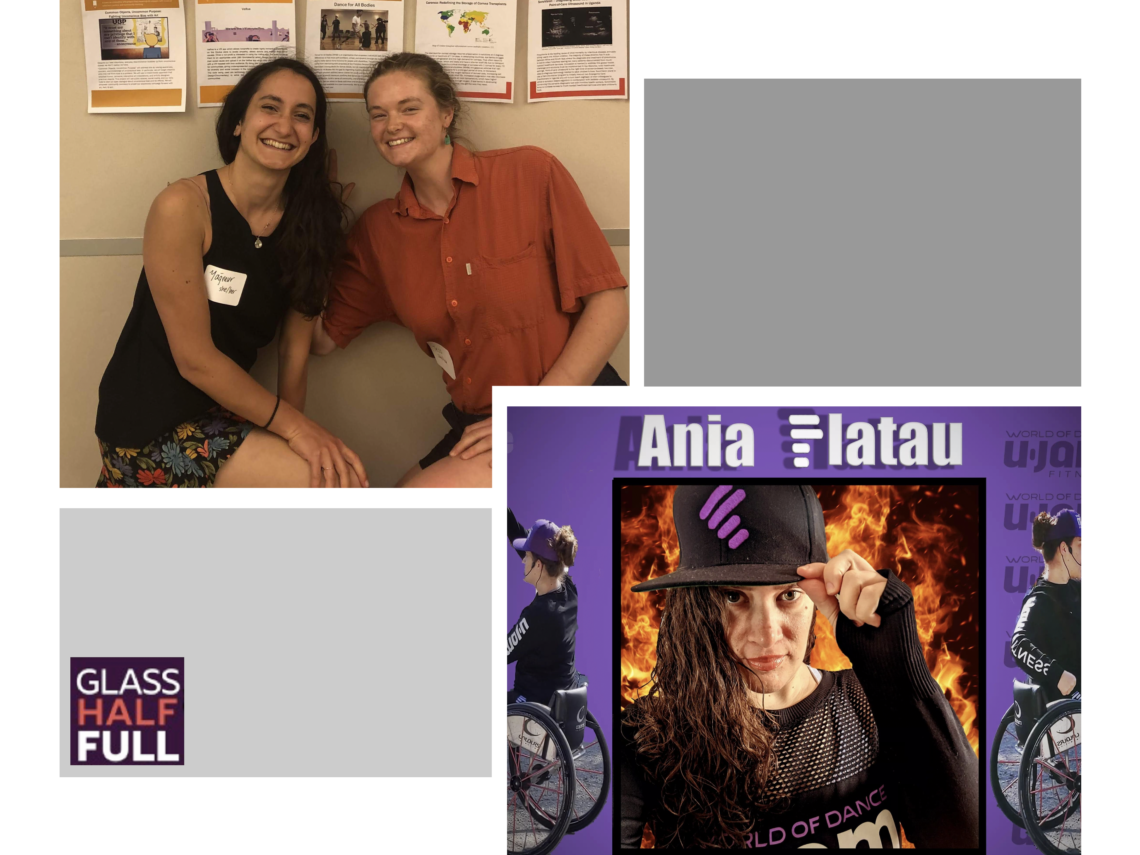
Yagmur Halezeroglu and Tess Hanson from Dance for All Bodies (above) and Ania Flatau from Wheelchair Dancers Organization
Several accessible dance organizations have brought their talents online and thus expanded their reach nationally and internationally. One organization, Dance for All Bodies, co-founded by two recent UC-Berkeley grads — Yagmur Halezeroglu and Tess Hanson — feature a variety of professional dance instructors teaching accessible dance in a variety of styles from salsa to urban jazz and even chair tap.
Another group, Wheelchair Dancers Organization, pairs wheelers with walkers, and offers online classes in Island Fusion, Hip Hop, Latin Jazz, and Bollywood. One of their wheeler instructors, Ania Flatau, also offers dance classes on YouTube Live through her Facebook group, Cat Daddy’s n Krew Virtual Fitness with Ania.
Loose Transcription
Hello…in this podcast episode I’m sharing more of my pandemic experience with you. A couple of months ago I interviewed two people affiliated with BORP – Bay Area Outreach for Recreational Programs. BORP is an amazing organization that has really stepped it up during this bleak 2020 by providing online classes.
But BORP is not the only group helping us cope physically and emotionally. Today you’ll learn about two other nonprofit organizations — Dance for all Bodies and the Wheelchair Dancers Organization.
My first guests are Yagmur Halezeroglu and Tess Hanson. They are the co-founders and directors of Dance for All Bodies which you’ll hear them speak about as the acronym – D FAB.
I found out about this online dance program through dance friends I met at Rumba with Tina which I attend on Saturday mornings. D FAB is relatively new and features a variety of professional dance instructors teaching accessible dance in a variety of styles – salsa, Flamenco, Brazilian, Hip Hop, Contemporary Ballet, Urban Jazz, Diaspora, and Chair Tap.
It’s fun, it’s educational, and it’s a good work out.
I asked Yagmur and Tess how they met.
Tess
“…we went to UC Berkeley” – applied for same job – Cal Performances. Ushers, assistant managers. Met fall semester. Yagmur had a lime green backpack. Realized we both loved dance.
Yagmur
DfAB started a one-time dance class I organized at hospital. Amputee community. Amputee support groups. There is a gap the way we view dance. Taking action and making change support what you believe in. Tess and I put this idea together. Big Ideas competition. How can we scale this class? Worked with AXIS dance company in Oakland. I ask about her work with the blind. Tess talks about the beginning. One of her brothers is autistic; James is a part of my life.
Now that both Yagmur and Tess have graduated, I was curious to know how they envision the future of D FAB.
Yagmur
We’ll just take It wherever it goes. Tess naively thought we’d need a year to get it sorted out. So many ups and downs. It feels like a good, worthy work in progress. They met at BORP at Ed Roberts. Once the pandemic hit, our lives just changed. Let’s try online…how did you find dance instructors? Judith Smith helped find instructors. Stephanie, Janpi – through word of mouth. Dancers with disabilities. We want to connect these dancers with experience choreographing.
Yagmur
Looking for partners and sponsorships. Challenges we’re facing. Initial award. Crowdfunding campaign in late March. We don’t have a source of revenue beyond donations. We want to compensate the team. Bring our classes to new audiences. Spread beyond our little bubble. Partner with a hospital. adaptive dance in schools.
I asked Yagmur and Tess how they feel about the past year and all of their accomplishments.
Tess
Tess talks about how people feel after the class; we get lovely messages that provide the fire to keep going. Can I do this? I’m really proud of the partnership with Wheels of the world – an accessible travel organization. We had a lot of classes in rapid succession.
As you can tell these young women are quite inspiring. I had just assumed they were both dance majors but they weren’t. Yagmur studied cognitive science and hopes to pursue medical school and Tess studied environmental health and policy and is currently doing field work for a water conservation group.
You can learn more about their organization by checking the links on the Glass Half Full website.
My next guest is Ania Flatau. I met Ania earlier this year because she was one of the instructors in an Island Fusion dance class I took offered through the Wheelchair Dancers Organization – or WDO. WDO was founded in 2008 in San Diego, California by Beverly Weurding – a woman who has Limb Girdle Muscular Dystrophy. Ania’s been attending WDO classes for the last four years.
I first asked Ania about the organization.
Ania
The classes are for disabilities…we call them rollers and walkers as partners. All the classes are for all abilities, all levels. Teachers who roll, teachers who walk.
Ania
Tell me about your love of dance; what were you drawn to? My parents are from Poland. When I was in high school. I was an athlete. I thought I was a bad ass. I felt so uncomfortable; he was pulling my arm. At the end I was so uncomfortable that I wanted to figure out how to do it right. One summer I took a trip to Poland and my parents found a dance camp for wheelchair ballroom. These dancers…dancing for six hours/day; they were training for the world championship. They kicked my butt. I remember feeling challenged…that’s where my love for wheelchair ballroom started. I started to feel more and more comfortable with my body. I felt a oneness that I had never felt before. I was…a senior in high school. I got into those fields because of the wheelchair dance.
Ania
Ever since that dance camp I’ve been doing something dance related. It makes me feel like I am centered in a world. Being a person with a disability…disconnected from your body. I feel present and centered.
Ania
I teach a dance fitness program world of dance u jam. We partnered with world of dance – a massive network. The songs are urban, like hip hop. When covid hit I…how am I going to get my fitness on? I was toying with the idea of teaching virtually. I created a Facebook group. the name is cat daddy’s and krew virtual fitness with Ania. A hip hop dance move called a cat daddy looks like you’re rolling a wheelchair. I was trying to find a creative way to honor the culture where hip hop came from and have an ode to the dance…cat daddies are wheelchair users and krew is everyone else.
So there you go…I learned something about hip hop. You can find out more about Ania’s Cat Daddy and Krew on Facebook; I’ve got a link to her group in the podcast notes and her YouTube Live classes are free. Ania told me she likes the accessibility features like the captioning that are available on YouTube. If you have any questions about modifications for the dance moves, she’s more than welcome to meet with you – virtually – to suggest options.
I hope you’ve enjoyed this episode but more important, I hope you check out the dance classes available at Dance for All Bodies, Wheelchair Dancer’s Organization, and Ania’s World of Dance U Jam.
Believe it or not, this episode has nothing to do with the recent U.S. election. We’re celebrating the 100th podcast episode of the Glass Half Full. But feel free to celebrate our right to vote in a democracy. All good!
Short video from the Glass Half Full YouTube Channel
If you’re a recent Glass Half Full listener, you can now peruse the archives of evergreen content that fall into these categories:
Advocacy
Alternative Healing Modalities
Autoimmune Disorders
Cancer
Cardiovascular Disease
Caregiving
Coping
Disability Rights and Accessibility
General Health
Laughter
Mental Health
Movement
Music and the Arts
Nature
Neurological Conditions
Nutrition
Relaxation
Research
Social Support
Spirituality
Technology
If you’re running out of ideas on how to cope with COVID, check out this list of 50 different ways to spend your time in a safe and sane manner. If you’re in need of online accessible exercise and relaxation opportunities, check out this page.
To learn more about Judith Nangekhe Nk, the health service worker and caregiver in Kenya, here’s a video.
Please visit the Glass Half Full store. You can buy t-shirts, mugs, stickers, and even face masks with the Glass Half Full logo.
Transcript:
Hello and welcome to the one hundredth podcast episode of The Glass Half, I’m Leslie and I can’t believe I’ve been doing this for over four and a half years. Some people might reach their one hundredth episode during the first year. I guess if you put out two episodes a week, you’d get there, you know, a little more than a year. People do, I know, five days a week. What does that mean? I don’t want to do the math, but.
You know, you get to your 100th episode when you get there and and I’m here and I’m.
You know, four and a half years ago, my intention was to take what I’ve learned over, I guess at that time it was about 19 years of being a facilitator of support groups for adults with neuromuscular disease to sort of take that experience, the knowledge, my my desire to share resources and knowledge, share my journey as a, quote, unquote, patient with others. All of that was the catalyst for.
This enterprise called Glass Half Full on the name, the term, everybody’s familiar with the term, but it hasn’t been something I thought about a lot. But probably within a few days of deciding to do a podcast, I thought of the name. I thought, well, I really do think that’s my attitude maybe when I was younger was as positive. But certainly over the years, at some point, maybe in my 30s, things shifted and I started to see life. You know, as certainly more positive looking toward, you know, how to make the best of something, the proverbial lemonade out of lemons, and that was when I was diagnosed was in my mid 30s, so. Anyhow, I I would hope that kind of perspective resonates for you, that’s why you’re tuning in now for the first time or for the hundredth time, how many of you out there have listened to all 100 episodes?
I don’t know. I don’t know how many there are if if you’ve done it.
I would love to know and your reaction is one of the. It’s one of the things that definitely can increase is communication from people who listen to the show. And, you know, I in fact, I was thinking of some of the highlights of the last four and a half years, it has been really I mean, you know, imagine you’re creating something every couple weeks, putting it out there in the world and, you know, you know several listeners. I mean, at least I do from my patient community, some friends, but. It’s been really wonderful when people contact me, you know, total strangers and they tell me they listen to the show or they’ll talk about something they learned from a previous episode, you have no idea how significant that can be to me or to someone who’s putting stuff out there and not really making money from it and doing it because they have a passion. So I invite you to to let me know. And there are many ways to contact me. I’m not cloistered in the middle of the woods. I’m fairly accessible. So I thought of three big things and, you know, impacted me over the, you know, nearly five years I’ve been doing this. Well, one was certainly hearing from people who listen to the podcast, whether it’s email or Facebook comment on the Glass Half Full webpage. But I have been to places where I met someone.
And when they hear my name, they or they hear about Glass Half Full, they, you know, tell me they listen to it and they’ll hopefully, I don’t think is sure that they didn’t like this show. But that has been really great. Another great thing has been, you know, over the years heard about different patient organizations, patient leadership groups, advocacy groups. And I met a lot of people through Those are the people living with a chronic health condition or disability who are doing their own thing, whether it’s a podcast, a blog, they’re fierce advocates and going to Washington, you know, or their state capitals. There’s just a lot of very amazing people, inspiring people interviewed several of them, too. But just about a year ago, I won trip from this group called Wego Health, and it was a free trip to Las Vegas where I was with, I guess, about 20 other patient leaders. And it was a conference that I can’t remember seeing HLTH. Ostensibly, it has some kind of meaning as an acronym, I think. But it was it was a huge conference of, you know, movers and shakers in the health, medical, technology arena. And I never would have gone to this without winning a free trip because I think it was a twenty five hundred dollars. So that that was really cool.
Never would have happened without this podcast. And another thing I don’t think I’ve ever talked about. And this is just, you know, representative of meeting people you would never meet, I had taken over a meetup group for people with chronic health conditions. This is when, you know, pre-COVID, people met in person. And I it was I think it was meant as a support group. In any case, I took it over because I wanted to reach people with other conditions, you know, outside of neuromuscular disease. And I like doing field trips to in the San Francisco Bay Area. There are just so many amazing organizations and resources. So I was doing like field trips and it was online. But the you know, ostensibly you’re you’re connecting with people who live in your region so that when you actually do meet up in person, you know, it makes sense because you live near each other. Well, it turned out there was a woman who was part of this meetup group from Nairobi, Kenya, in Africa. And her name’s Judy. And I guess we chatted a little through meetup and she told me she was in Africa. And I knew well, she’s probably not going to make it to any of our in-person meetings. And somehow I can’t even remember how one thing led to another. But I felt that she was a health services worker.
She worked with people affected by HIV and AIDS. And I’m still I don’t know if she’s a nurse, but it sounds like she does a lot of nursing and administering of materials and education, so. We tried to talk, but at that time, maybe two years ago, her cell connection was really unreliable. But I worked on a video. It’s on YouTube, I think it’s called Judy: Caregiver. I did a video for her and she really appreciated it. And just recently, she asked if I can do another one. And she was able to provide audio files so it’s in her voice. And so that it just it just dropped last week. It’s on the Glass Half Full YouTube channel and. I think it’s Judy and her last name, which I can’t pronounce, but you’ll see it there just came a week ago. Anyhow, she’s using it to raise money through different churches in the West. I assume U.S. Canada, maybe Europe to English speaking countries raising money for the work that she’s doing in Nairobi, in and out, in and around Nairobi. So those are just some examples of things that never would have happened had they not started Glass Half Full. By the way, this is not scripted. If you if you didn’t know mostly I write a script because right now we’re at 18 minutes. And if I you know, if I’d written a script, I’d probably be at 12 minutes.
Oh, maybe 10. So just thought I’d do something novel. There’s a video, a short video that’s in five minutes showing. All these different images from, you know, almost all of the 99 podcasts and it’s on the website, it’s on the YouTube channel and I have a few actual video clips in it. One is part of an interview with Susan Jermey. There was an interview I recently did. She’s a comic and playwright. Another is a clip with Mike Muir, who is the great grandson of John Muir, and it’s at his ranch. If you listen to that podcast episode about three years ago, Mike, has he was diagnosed with M.S. years ago. I think he might have been a teenager he was definitely younger. And he he has this accessible ranch, horse, ranch, and he does carriage rides. And so he uses a wheelchair and the ranch is open, you know, for adventures, for all different kinds of people, kids and adults who use wheelchairs. And it’s, you know, accessible experience. So I have a clip from that. And then I have a clip from Melissa Felsenstein, who is a sound therapist, sound meditation practitioner. She uses gongs and crystal bowls and all kinds of different instruments. And the podcast episode with her, I think was about two years ago.
Andhow, she’s she’s still doing her thing and doing it via Zoom now. So I invite you to check out that video.
And in the course of putting that together, the video, I went through the whole archive of ninety nine podcast episodes. And by the way, most of these episodes are what you call Evergreen. They are. You know, they they’re relevant now, as relevant as they were when they were published, you know, three, four years ago, some of them are tied to events that have happened in the past. But it’s always been my intention to put together, to produce an episode that has lasting value, you know, so unless There was something, you know, we talked about and it’s now been proven to be not good for you, I can’t think of anything. I think, you know what, I do focus on alternative healing modalities, but nothing that is so far-fetched that, you know, in two years, somehow it’s been found to be not good. So anyway, the point is, if you haven’t heard a lot of the episodes, go back, check them out. And now there’s a feature on the home page where you can search by category. So, you know. I didn’t know how many different categories I would have, but I went through and I identified 21 categories. OK, so I’m going to tell you the 21 categories now. So if a couple of these pique your interest and you haven’t heard episodes relevant to this theme or category, go to the home page GlassHalfFull.online I found that online and check them out. OK. Drum roll please.
Advocacy, alternative healing modalities, autoimmune disorders, cancer, cardiovascular disease. Caregiving. Coping. Disability rights and accessibility. General Health. Laughter. Mental health. Movement, Music and the arts. Nature, Neurological conditions. Nutrition, relaxation. Research, Social support. Spirituality. Technology.
There you have it, 21 different categories, now some podcast episodes, you know, cover two or three of the categories. So they would come up, you know, in a few different searches. But it’s a drop-down menu. Hopefully it’ll make it easier for people to look at the
Archives, the library of episodes. Another thing that you find that’s new on the Web site is a link to a storefront, So over the past four and a half years, I’ve given away some Glass Half Full schwag, mostly mugs. I have had some T-shirts, a couple hats. But now you can buy whatever you want. You can buy a face mask with the Glass Half Full logo on it. And this is all through a company. I won’t name them. If you go to the website, check it out. But this is one way for me to capture a little revenue and for you to help promote the podcast and the concept. Of Glass Half Full and positive psychology, positive vibes. I really appreciate if you want to get any of your holiday gifts. I mean, imagine if you got each of your family members a mask. You’d be helping them with their health and you’d be helping me and hopefully helping other people who see the mask and think Glass Half Full, I want a piece of that. So. Spread the goodwill. Well, I don’t want to make this whole episode about promoting Glass Half Full, but what can I say? It’s a hundred. It’s you know, it’s that point where you want to celebrate and also continue to grow. So, you know, I’ve seen an uptick in downloads over the past few months.
I’ve been working on some SEO, which is search engine optimization, which is not fun. But seeing results does motivate me to do more of that. And really, if you if you’re not familiar with the term, it’s just tweaking things, you know, on the website with text and keywords that will help for searches when people go to the Internet and want to search for, you know, under a health condition or just a concept, maybe it’s, you know, November and they’re, you know, thinking about gratitude and they want to learn more about gratitude so they can practice gratitude. Well, will Glass Half Full come up in that search and gratitude? I don’t know. I’m working on it. I hope so, although gratitude is one of the themes I think I have gratitude covered under spirituality, which, you know, this is all in my head, too. And it’s not like rocket science. I could have gratitude as one of the categories, but I try to be a little more open ended with the with the categories, I didn’t want to have like 100 categories. So there is also a link on the homepage for accessible exercise. And I would say that accessible exercise as a resource is also a part of this other page I put together just a couple months ago at. I spent time on this 50 ways to cope with covid, so I haven’t been promoting that; it was a special feature for some groups, but now I’ve opened up, unveiled that it’s open to the world.
If you feel like you’re running out of creative ways to save your sanity during lockdown or, you know, the cases now are surging or the COVID cases are surging. And during these winter months, it’s going to be even more important to refrain from. You know, being in other buildings, being around a lot of people, we’re just taking our time, we want to protect ourselves. I have only been in one other building and it’s nine months other my house. And that was to, you know, Kaiser Permanente, the health facility I go to for some minor stuff just one time. So anyhow, what am I saying? That’s why I used the script. So 50 ways to cope during covid. I invite you to take a look at that article and accessible exercises, part of it, but so are a lot of other things. I am also doing covid had two speaking engagements, of course, via Zoom Virtual, but I wanted to share them with you. They’re listed on in the podcast notes for the 100th episode. So one is a presentation I did on nutrition and maintaining immunity during covid and that was for a Muscular Dystrophy Canada organization.
But it’s, you know, a YouTube video so anybody can watch it. And the other one, I’m very delighted to say, is that I was the keynote speaker at the Utah Program for Inherited Neuromuscular Disorders Family Conference, and that was just about, I think, three weeks ago. And then also on YouTube and I spoke about making social connections and talked a little about my background and what led me to become now a master of social connections. But certainly I’m as I would say, Malcolm Gladwell would say, I’m kind of a connector. At the end of that, toward the end of that presentation, it’s really focused on Zoom related connections and communities that I’ve become a part of. You know, during COVID that I wasn’t pre COVID, so I have talked for 24 minutes pretty much non-stop, can’t believe I did it and I only, I think, sipped water twice. I don’t know, maybe I should dispense with scripts altogether? Let me know what you think. How does this compare to my scripted ones? So thank you for being a part of this Glass Half Full ride. I hope you continue listening. I’m working on some very interesting episodes that several of them will happen before the end of the year and some won’t reach completion until early next year.
But, you know, keep tuning in and take care of yourself and celebrate!
Four women with different physical abilities talk about what fashion means to them and how they deal with fashion challenges.
Cheryl and Lainie both have Charcot Marie Tooth (CMT) and wear AFO leg braces. Lainie explores fashion hacks and DIY solutions in her blog, Trend-Able.
Keisha has Limb Girdle Muscular Dystrophy, studied fashion, and launched her company, Girls Chronically Rock.
Kirsten Passmore has Cerebral Palsy and has been enjoying CosPlay for the past five years. Learn more about her organization, CosAbility, and see which conventions they’ll attend by liking their Facebook page.
Holidays can be tough; that’s why we’re focusing on our favorite things. Peni, Laurel, and Kristl share their voices and 22 previous podcast guests tell us how they beat the funk when dogs bite or bees sting.
Since this is the shortest podcast episode ever…check out these previous episodes all about optimism:
Passion: Motivation to move through the bad stuff and experience joy
How do you give back? In previous podcast episodes we heard from Amy – a music philanthropist – who sings to raise money for causes she believes in, Chris – a software engineer – who has been involved with a nonprofit organization that helped him as a youth, and Hazel – a retired government employee – who teaches others about service dogs.
Today’s episode features Susan, diagnosed with breast cancer in 1987, who helped the Women’s Cancer Resource Center thrive; first as a volunteer and then as its first executive director.
Sound therapy has become a wonderful tool to access deep relaxation. For many, it is a gateway to meditation. Melissa Felsenstein of Inner Sounds Meditation shares her story of how playing crystal bowls and metal gongs helped her heal from symptoms of anxiety and depression. A self-proclaimed Nervous System Advocate, after several years of exploring these musical instruments, she now shares her process to help others.
Check out a video from this Summer Solstice Sound Bath.
Transcript
welcome to glass half full with leslie krongold she shares her stories experiences and knowledge of living and coping with a chronic health condition learn about tools and resources and hear inspirational interviews that help you to live a life filled with quality and dignity with two decades of support group leadership leslie’s ready to help you make lemonade out of life’s lemons are you ready are you ready welcome to the summer if you listen to the last podcast episode about nature i hope you’re now trying to get a daily dose of it vitamin n that is this past week i was quite fortunate to get this great double dose of vitamin and at the university of california’s botanical gardens in berkeley on wednesday i attended my first forest bathing led by a certified forest guide but the two and a half hour experience ended in a redwood tree grove and on thursday morning i found myself in the same grove i didn’t sleep there overnight and i was not kidnapped and taken there but i returned for a solstice sound math i would assume most of you listening out there have never been to a sound bath but it’s an experience i bet will come your way soon my first sound bath we always remember our first time right was nearly three years ago in july at a yoga studio in oakland california sound practitioner was melissa felsenstein and she is my guest for today’s episode so perhaps you’re wondering just what is a sound bath is it always experienced in nature and how is leslie able to read my mind
often i use wikipedia as my go to web page for a solid definition of something but there is no entry for sound math i’ll have to rely on my experiential knowledge so you know when you’re in a bathtub you’re enveloped in water for me this is a truly relaxing experience well in a sound bath you allow yourself to be enveloped by the sound not any sound like i don’t think any cdc concert would qualify but you know who knows melissa uses crystal balls gongs and chimes to create her sound math i’ve been to several sound experiences with different practitioners sometimes it’s called a sound meditation or sound symphony where other instruments in addition to bowls and gongs are used such as a harp wooden xylophone and even a human voice each sound experience is unique many factors contribute to the overall experience who is the practitioner what is the environment like if it’s indoors what are the acoustics like how close to the practitioner am i seated or am i reclined do i shut my eyes and let myself be carried away or do i remain seated so i can watch and listen on thursday i chose to have my eyes open it was a gorgeous sauce this morning in a redwood tree grove and i wanted to videotape portions of melissa’s performance best to keep my eyes and ears open for that what you’re listening to in the background is from that day in the redwood grove you can hear birds communicating in the background and actually when melissa stopped playing the bulls and gongs the birds really went crazy i think they were beckoning for an encore you can already tell i’m partial to melissa’s sound performances i’m a fan shall i say her journey to this work and you know and now after three years she’s making a living as a sound practitioner or healer anyhow her journey is what this episode is all about you can watch a video of the solstice sound bath on the glass half full youtube channel but it’s a best experience live a link to the inner sounds meditation website is in the podcast notes and that’s melissa’s website so i was introduced to sound as therapy in 2008 and i was traveling india and i was at one of those bazaars there was this big market i walked into one that i had i’d known about the tibetan bowls the metal ones they’re metal bowls that are handmade in tibet and in india this was in rajasthan so it’s the northern part of india and so i i went there i saw i saw this this shelves and shelves of metal bowls and i thought oh that’ll be a really fun thing to have and i started talking with the man the store owner and i kept kind of coming back to it like we were there for a couple of days and i kept just wanting to be around this man and just sort of talking with him and i helped him with his business card and some other things and we were just kind of becoming friends and eventually he told me that he used these bowls he used the sounds to help heal children specifically of different ailments and that’s what he was known for and i remember i had this moment like oh my gosh like i’ve always been interested in music i was a dancer so the idea of sound as a way to help people i was just so blown away and i thought and then he was showing me some techniques and i eventually bought a bowl from him and then i convinced him to give me his mallet you know he didn’t want to give me like his mallet but i really wanted his mouth i felt like he was infused with this like power you know and he was very reluctant but somehow i convinced him um and i uh yeah so i came home and i was so inspired from that trip and i thought i’m gonna become a sound healer and then i got home away from india back in the grind of los angeles and i was like that is a crazy idea like who who would ever want that you know i completely denied the dream like i felt the dream and then i i denied it and i was working a corporate job and i just continued and then it’s interesting how you know you have this little if it’s meant to happen it will happen right so i i said i said no and then of course you know a short time later it came back to me like a boomerang i think i just felt like it was just too wild you know and anyway so needless to say um a few years later uh my father fell mentally ill so he was dealing with bipolarism and he was on lithium but then the lithium was really hurting his kidneys and so he was abruptly taken off the lithium by a really bad doctor i don’t know you know someone is a certain way and then you have no idea what might happen really when they’re taken off their meds you just assume it’ll be fine kind of you’re like well what’s gonna change really well everything changed for him everything changed he became manic and he just never recovered he was manic for eight years until he died so uh in the beginning you know he was on the street and it’s interesting how the system i i’ve said this before but the system doesn’t really care that that person was an mit graduate on a scholarship i mean my father was brilliant he worked for hewlett-packard his entire career starting right when he graduated from mit just this really brilliant man very kind and soft-hearted and always taking in stray animals and just a very introverted introverted quiet genius and but the system doesn’t care it doesn’t care that what you were you’re just like another person you’re another number and so he was lost in the system of just mental hospitals and um all sorts of situations that i i don’t really want to go into too much too much detail because it’s um it’s painful but we’ll just say that it was it was a really bad time and so i was very close to my dad i’d say we both had this kind of wild adventurous self that we both understood and we were both a little bit weird and we liked like kind of things that were a little different from other people and he really encouraged me to be an art major he loved the arts he loved that i loved music he loved that i danced so it was really supportive and just i don’t know fun we were like pen pals during that you know my college years so anyway when he got sick um i was doing yoga i was doing kind of your typical exercise and but my nervous system was becoming so
it was becoming so severely imbalanced because i was so afraid all the time for my dad i was afraid for his health i was afraid for my mom’s safety i was afraid for everyone else’s safety he became kind of a dangerous man he became an angry man so um and his his own safety for himself and uh it just became too much you know there’s a certain amount of stress you can deal with but then when that stress keeps going like whether it’s a chronic illness right you understand that and just dealing with this something that’s relentless it doesn’t it doesn’t ever let you go and you don’t know what’s down the line you don’t know what’s down the line you have to become it’s very uneasy it’s unsettling you can’t ever get kind of grounded and feel confident or sure and i think about that like chronic illness or or cancer treatment and sort of my experience too there’s a lot of commonalities and i think a lot similarly this happens for everyone’s nervous system that’s under chronic intense stress you know basically like everyone else i stopped sleeping i was insomniac um because i just couldn’t rest my mind at night so that and then i stopped sleeping then i wasn’t able to eat and digest you know i could barely eat anything i was losing weight i felt sick all the time and bloated and it just felt awful i had migraines i had tmj i had teeth grinding and eventually it got to the point where i had like a shake as well like like and i was losing my hair i mean it was wow severe anxiety severe severe anxiety and as that started to compound i was also greeted with depression because you start to really feel down when you can’t get yourself healthy and you’re seeing you know i think depression it’s different from sadness i mean i was sad about my dad but depression is this there’s a quality to it that’s um so gray it’s so bleak and i could feel that with just this idea that tomorrow is going to look exactly like today right and when you look into the future and that’s all you see is a broken body and sadness grief you know at the time i didn’t realize i was grieving the loss of my dad right like i had lost my dad he was here but who he was was someone like completely foreign to me occasionally over those seven years i’d see this little spark and i’d remember who he was and he’d do a little joke or something and it gets me like teared up just thinking about god it was such a hard time um but was there also an element of fear that this could be your future oh yeah that’s a really good point yeah like i looked into my own future and i was like oh wow this could be it because i was still going to yoga classes and i remember being so like angry and i was very bitter a lot of the time because i was so um mad that my life was lost and my dad’s life and my family my family you know we were sort of broken up by the situation as any family would it’s very very hard to deal with mental illness i asked melissa about her reintroduction to the sound work how did she recapture that dream she originally had in india so i would go to these yoga classes and yoga had always been my savior it always been my refuge and i would sit in shavasana i would just steam i was just so mad because like i kind of felt like even that was taken from me like no matter what style of yoga i did it didn’t work i was doing acupuncture which i always felt exhausted by like i felt like it took something from me to show up to get there to receive treatment and then afterward i was always super tired reiki same thing i tried talk therapy i tried some western medicine i was basically just doing anything i could and i just i just didn’t have any extra energy for anything i was barely able to kind of just show up in my life and just kind of just get through the hours of every day so a few different people um encouraged me to take some time off and i and i did and one person actually said she was like you know i really she was my my therapist and she said i think you should like go to an ashram so i did i did and it was a brilliant move because they’re so disciplined there’s a lot of chanting and that’s kind of when i opened up to this other side of yoga that wasn’t just asana you know asana is the movement it was the chanting and then the meditation um and you know just kind of broadening out what what this concept of of yoga was and at the same time i was taking some classes around my neighborhood and i walked into this class and little did i know at the very end in shavasana she plays a crystal ball and i just had this moment where i could feel my whole body responding to the sound you know that deep deep relaxation and i could feel even my nervous system kind of calming down and it was really brief you know it was only like a minute or two and i just thought i don’t care why or how i’m just going to i walked up i was like what is this i didn’t even know what it was she’s like this is a crystal ball and i was like what and then i just bought them and i had them delivered and i taught myself how to play i bought i bought three of them from home shop in florida no they don’t make them there no no almost all the bowls are made in china actually but um so uh and they were delivered in like you know eight business days and i just unpacked them and just started to play them because i just at that point i was like i don’t care what it is i don’t care what tool it is because i i think i think the pivotal moment too wasn’t just how i felt when i heard the ball and i think it also was that it created hope for me a hope like that future that i saw before that we were talking about where every day is the same and you almost just want to give up you know it’s like why keep living why do i want to live i don’t want to live like this you know and i think a lot of people are confronted with that um often in our lives uh but so it brought me this tiny bit of hope like maybe it could be different maybe i could just try and use this so the sound came back to me under much more rough circumstances um and you know unlike some sound healers uh sound is taking off right now and there’s a lot of different healers out there but i think the thing that makes it slightly different for me was like it was necessary this wasn’t a choice it wasn’t like i like gongs these sound so pretty they’re fun they are fun they’re outrageously fun to play to feel it in your body as you play it’s amazing and i could see that draw but for me it was necessary like i had to do this every day if i wanted to become well again
i don’t know i just feel like the gongs what what they did for me i felt like you know i started for like a month or two with just the bulls and they really rewired my nervous system but i was missing the jump for my depression like i still couldn’t quite mitigate that and um i think the gongs really help with that because they take you into this ethereal meditative open space so when i got the gong it’s jupiter jupiter was the gong each of each of the gongs have a um they’re a certain note that’s aligned with the orbital properties of each planet and they have they have the base note and then they have two overtone notes as well that’s how they’re different from orchestral gongs which are not tuned at all so when i have eight gongs or something i can set them up to be very harmonious based on notes or feelings or dissonant you know but orchestral gongs you can’t do that they’re all just set they they’re tuned to sound pleasant but that’s about it so these are really special instruments and they’re so high quality they’re all made of an alloy of of metal oh okay so they vary in what they’re made of well depending on the maker yeah every maker has their secret recipe so piste’s got a recipe and meinel has a recipe and um nobody wants to give up their secret recipe because it’s a combination of different metals okay to make the sound and of course you know there’s also there’s gong gongs have been around for thousands of years um so there’s chinese gongs and tai gongs and burmese gongs and how did you know you wanted to go to gongs like yeah that’s that’s a good question i don’t know there was an intuition that just you know i did go to a few sound meditations at the time in l.a and i would go and i would feel this like distinct calling like if if i really really want to feel healthy i’m going to need this and i i think it was so it was intuitive but once i got it i did notice a big difference in my healing experience
it’s very hard to describe this the state of being
i always struggle with it on paper and through voice because it’s like a place that’s beyond time i don’t know it’s a place beyond words it’s a it’s a feeling it takes you into this almost like to the soundless place that’s where the gongs take you it’s like you’re you’ve got to prepare the the mind you got to create the pathway in into the silence and i think the gongs really help with that and when we can find silence in different ways rather than just through meditation which is so hard for most people including me i mean i became a meditator after i used sound as meditation as a meditative tool but um so we all struggle with sitting there you know and in yoga they they have you do pranayama first so that way you can do a little breathing technique and then hopefully get your mind ready well in the same way that’s what the sound is doing the sound is stimulating your mind it’s stimulating your senses it’s stimulating your cells it’s vibrating everything it’s unpredictable the gong i don’t even know how it’s gonna show up you know some days i do a hit that i’ve done a million times and it just looks like crazy um so it’s very unpredictable and so the mind can’t um the mind relaxes in that actually it doesn’t it doesn’t grasp it’s not able to grasp to rhythm you know it sort of has to deal with unpredictability which is good because it makes it more flexible but the the sounds i think or this is what i know the sounds of the gongs
are trying to prepare your mind for the sounds without the gongs to prepare it to kind of clear those everyday thoughts out of the way with sound because it takes over just it’s not going to let you spend a lot of time thinking about your grocery list
melissa explains how her playing of the gongs was a healing process remember she was doing this on her own still the gongs and the crystal balls were tools for her own healing also getting a lot of strength from that space too right resiliency you kind of feel like you can get through these difficult points of our lives and you know my dad’s story you know as as i got better and better and better you know dad got worse so you know right as i was launching my business my dad was dying you know so um and i’m smiling right now which no one can see uh and it’s because you know he brought me the biggest gift like would i have found this if everything had stayed the same probably not or maybe it would come to me in a different way we don’t know um if you’re meant to do it apparently it comes back again again yeah but uh yeah i mean his he’s he’s he’s an inspiration for it and also i really felt like the sound as therapy and for myself really expanded my capacity to just handle more you know and so even though dad was going through so much i felt very robust and i let go of the need for him to be the way he used to be and i accepted who he was and i accepted his own karma if you believe in that his own path like i can’t change that it’s what his soul needs and i can just support him with love and kindness and caring and it really having those kind of realizations helped immensely with the guilt and the pain
and i’d say i really started to feel better about a month into it and then really powerful changes in the nervous system three months later and i’d say the depression was really reigned in and sort of obliterated probably six months into it wow so yeah within a year i was already doing really i was a really different person and over the years people were like wow you’re so less gritty like you’re so much more soft i used to be really kind of intense and kind of feisty so it’s it’s it’s changed my pulse you know it’s changed my own vibration and and um but it was you know i started out with myself and i remember my friends they were like what have you been doing you seem different and i was like well i was kind of embarrassed about it i was like well i kind of do this stuff with sound and they’re like what i’m like they’re like that sounds cool like they’re all into it you know and i was like i don’t know and they’re like we should you should you should play for us and i was like i don’t know about that it really like i was pretty reluctant to share um for many reasons you know i kind of felt like well what kind of person is a sound a sound practitioner i’m even afraid to say healer it just feels too heavy what kind of person is that like who does that you know and i’m like that’s not me i like to eat hot dogs and hamburgers bacon i love bacon god if i could have that every day i would and i love to like drink wine and i i’m very standard in many ways just like i’m just a normal chick like you know who is this and so i was very um embarrassed and even when i first moved here you know that was a three years ago i launched my business full-time after doing a few of those events you know and then kind of growing a little bit in la but but i knew i just knew i needed to come here i need to come back home this is where i’m i’m bored i was born in south bay and now that melissa’s been sharing her healing tools with others for over three years she’s learned a lot about the instruments and how people respond to her performances i asked her to elaborate on this it’s organic and you’re really like for me i’m just listening i’m listening so intensely to wait and sort of find the sound that’s special because every sound meditation has several of them and it’s a it could be a rhythm it could be especially with the gongs the bowls are interesting how they show up every time too a little different but the gongs they definitely have their own
individual way to them for each one and so i’m just searching i’m looking around and just trying to find okay where’s that nice and i hear it and i’m like oh what’s that what’s happening here and i’m like oh that’s exciting you know even after years and years and years and years of playing i have those moments every time or where one gong who normally plays very dark and deep is showing up right what’s this about what happened and i’m sure you could go into all sorts of like um the physicists are always like well it’s the temperature of the room and this and that but really i i think there’s something more to this that’s um less scientific and less rational because i could have the same exact two gongs playing for a private session and the person changes but nothing else does and they show up differently and i think that’s also me as a practitioner because like i said i i’m intimate with these instruments they were a big part of who i am and who i’ve become and i have a great respect for them so i’m really i could there’s many people who just want to you know aggressively go at the gong because it’s so exciting it’s so stimulating and it’s fun as a player it’s fun but as a recipient it can be create a lot of intensity and i’ve heard so many people go to these other experiences and say i hated it you know i will never do it again i found that to be like i was panicked the whole time and it’s because your nervous system you know doesn’t understand these sounds and they sound scary and they it just goes into fight or flight so as a player i’m very aware of that and because i’m a nervous system advocate and i’m trying to re-teach people how to relax i’m trying to calm their nervous system down and to clear their minds that’s my intent it’s like a healing environment i am mitigating the gongs quite a bit you know what i mean i i’m really working with them from that standpoint it’s almost like they know that that’s what they need to do and i know that’s what i need to do so but they will play very very very differently and we’re talking like nothing else in the environment has changed so you have to wonder well what is that about well it depends it depends how scientific you want to be or if you want to be open to you know the potential that there’s some greater forces happening that affect how they show up but it’s this idea that this is what i mean by there could be something more and i think there is i’m saying could because i’m being a coward well do you think the energy of the people yeah okay i think so the energy of the people that i understand right you do but you know the average person i don’t know um but yeah the energy of the people um and i get a lot of intuitive because i’m going into a very meditate meditative state i get a lot of intuitive hits as well about people so about like a stranger i don’t even know them but as i’m playing you know there’s a rhythm and there’s a feeling and i’m like oh
i had a few questions from melissa that were less about her journey and more about the science behind the use of sound as a therapeutic tool i asked her to talk about brain entrainment a term i wasn’t familiar with but is often mentioned in this line of work so entrainment is the ability for our brains as animals as humans um and animals to synchronize and so this is how large fish can swim together as one organism or if you’ve ever seen a huge group of birds and they’re might and they’re they’re turning like a mass and it’s not because they’re talking to each other like let’s make a left no it’s because they’re entrained they’re near each other and they’re synchronized two heart cells placed near each other but not touching synchronize pendulums synchronize together um in a conversation actually there’s entrainment with body language so if i were to sit here and put my my chin on my hand you might eventually do that if i rub my nose you’re gonna rub your nose actually that happens every time because people are worried about like is this the whole mirror neurons yeah it’s mirror neurons yeah and yeah entrainment so um in this case your brain waves are synchronizing with the sound waves and the sound waves have tons of properties that induce deeper states of slower slower brainwave states or deeper states of relaxation some of it’s the tonal qualities they have high tones and low tones going together they have very low frequency tones as well that can help they aren’t pure notes so they’re normally flat or sharp by a random amount as your your brain receives these tones it entrains and naturally starts to slow down and it’s through that process that you can go into these deeper states so you can drop into the beta state you know relax tape and the theta lots of people drop into delta as you know so delta brainwave state is deep deep sleep so it’s the kind of sleep that you get after like massive travel right and you’re so tired and you’re like oh my god i’m exhausted boom and then 12 hours later you wake up so it’s like that but imagine getting that in just a one hour experience and say you get 45 minutes of it and it’s rich sleep
my belief you know there’s been a lot of connection around sound healing and cancer treatment my feeling is you know with some of these conditions fibromyalgia chronic pain conditions where our sleep is affected i really it’s extremely nourishing because it’s that rich rich sleep and they find that people are falling asleep and sleeping eight hours but we wake up and we’re tired and there’s disputes about that right maybe it’s you’re waking up at the wrong time of your cycle of your sleep cycle but there has been some research um of late that says that actually it’s you’re not getting delta because we go to sleep and we’re thinking about all these things and we’re stimulated by the ipad and whatever else that we’re using which i’m guilty of and many others right we’re we’re on the line or we’re reading a book or something and we’re too stimulated and we sort of fall asleep thinking about our to-do list and then we wake up thinking about our to-do list and we’re not rested because we’re not actually getting that sleep but you can train your brain and that’s what the sound does so it’s cumulative so each time people they come to the sound meditations and their brain through neuroplasticity which is so amazing right we used to think that your brain was done growing at like 17. and now we know oh my god brains are changing all the time all the time and so you can get better sleep i mean i’m proof of it right like you can restore your entire nervous system from you know it was [ __ ] before to like robust and healthy and healthy immune system and everything just with sound that’s what i did but it’s not some kind of snake oil it’s through science you know if you can get into these delta brainwave states and your brain also starts to learn about the theta brainwave state which is so hard to describe that was the space i was talking about you know inner space a place that is boundless it’s free every time i walk in i it just gets bigger you know there’s so much space in there and there’s so much beauty and it’s a feeling um but your brain starts to get used to it it starts to unlock and become more comfortable with these states that we’re becoming less and less aware of and our ability to get into them on our own is becoming harder and harder simply because we’re being pulled in so many directions right like technology has been great but now we’re always kind of multitasking and the brain necessarily wasn’t made for that or the nervous system the nervous system hasn’t really improved in the way that technology has right it’s an old system so your nervous system doesn’t realize like oh actually i’m not being chased by a bear i’m just late to a meeting like it could be worse right it can’t differentiate but and the body responds in the same way either way and that’s where we get destructive with stress that’s when stress becomes destructive but there’s ways that are easy have no side effects you know sound has no side effects it has only benefit and you know when i said in the very beginning i was doing these other modalities and i felt like they took away from me and i had a private client say the same thing and he so beautifully said he’s like when i come to sound it always feels like it gives to me it doesn’t take it just gives and i love that about it as a therapeutic tool i hope you enjoyed this episode perhaps you might consider exploring this healing modality by attending a sound bath in your area or even trying to see how you react with different sound tools watch the youtube video segments on glass apple’s channel to learn more and check out melissa’s website thanks for listening thank you for listening to glass half full leslie invites you to leave a rating and review on itunes this helps spread the word to others dealing with chronic health issues for show notes updates and more visit the website glass half full dot online last half full dot online
International Dance Day is April 29th. Here in Northern California we have Bay Area Dance Week with all types of free dance classes and performances. As Judith Smith, co-founder of the physically integrated dance company, AXIS, says, “Everybody who is in a body can dance and move — it’s a right we all have.” And that is the message of this podcast episode.
Years ago when I held my first dance marathon to raise money for the Muscular Dystrophy Association a banner hung with the slogan, “Dance for those who can’t”
Fundraising event for MDA held in a mall in North Miami Beach, Florida ~ 1978
and that sentiment couldn’t be further from the truth. The AXIS Dance Company has included artists with physical disabilities, commissioned award-winning choreographers and composers, toured 100+ cities, and appeared on Fox TV’s So You Think You Can Dance. Opportunities for adaptive dance exist from here — BORP’sWorld Dance for All — to North Carolina where Mindy Kim teaches chair dancing.
Leia Cash, a lifelong dancer and educator, teaches adaptive dance classes at the Ed Roberts Campus in Berkeley, adults with Parkinson’s disease, and seniors at a residential facility.
Singing along to classics from my youth definitely has a positive effect on my mood. From sharing a karaoke night with friends to learning about music therapy from a licensed creative arts therapist, this episode explores the healing power of music for young and old with conditions ranging from autism, dementia, and Parkinson’s disease to persons healing from trauma.
Laurel Roth Patton — mental health consumer, advocate, speaker, and writer — and I talk about our different karaoke experiences. Juliane Kowski, LCAT, MT-BC, MA — of Music Connects — discusses what music therapy is and how it varies depending on the client and what they need.